About

  • Our Studies

Our Thinking

  • White Papers
  • Our Studies
  • Integer Pulse

Follow Us Here

  • Add to Technorati Favorites

Subscribe
Share/Save/Bookmark

Shopping

Inconvenience

We've a project going on in the Denver office on the notion of convenience. So this little blog has been set up by Paul to discuss the opposite - those things that inconvenience and bug the hell out of us.  He's looking for comment and stories about things that get on your nerves and you see as inconvenient in your day-to-day life. We thought we'd enlist our Shopper Culture readership to contribute the things that you all find inconvenient in your day-to-day life as we're sure there is a lot!

Inconvenience
So please have a look and leave your own story of things that are not convenient to you somewhere on the blog, or feel free to email Paul to add to his collection of stories. If you also find your way to pass this on to other people you know get riled up by life's little inconveniences, that would be fantastic.

Thanks

Point De Ventre - Paris

Paris recently hosted a Retail Marketing event called Point De Ventre. Ian Whitney from our Paris office went along, shot some video and made a quick presentation of some of the innovative technology that delivers meaningful shopper engagement. 


Great sign-off Ian!

Is 'Bargaining' the wave of the future?

Watching the Today Show one morning last week, and then 9 News here in Denver that same evening, I saw similar stories about the rise of bartering by consumers. 

According to these reports, in the United States at least, consumers are beginning to bargain with national retailers to negotiate pricing. The Today Show specifically talked about how New York consumers were beginning to “bargain down” the prices. Walking into stores along 5th Avenue, shoppers are speaking with sales associates and managers to get the pricing down to a level that they are comfortable paying. Initially it took me a few days to digest this.  I was completely in awe over the concept of walking into a high-end retailer – say Tiffany’s – and speaking with the manager to “barter” with him on the price! This is something that many of us would do when vacationing in Mexico, or when in China on a business trip as it is part of the culture in those countries, but in US retailers? 

The thought has occurred that our current economy could easily be pushing us in a similar direction. Not only might that be beneficial to the shopper but it can also benefit the retailer if they are able to move their inventory quickly and generate a sale. But is America daring enough to barter in this way? Is it ready culturally? We have all seen the rise of bartering over products online – EBay, Craig’s List, etc.  But, that’s online and there is no face-to-face contact involved, nobody to cast judgment over what you are doing. Yet bartering online had to start somewhere, as does bartering in person I suppose.  The 9 News piece has interesting tips for how to approach it; things like who to talk to in the store, where to start, how to do your research beforehand, etc.

It will be interesting to see if and how this will evolve over the next economic cycle.  How will this change shopping habits?  What will be the response of marketers and brand owners? Advertising and other communication?  What does this indicate about our country and the US shopper / retailer relationship?  Is bargaining the wave of the future?

- Contributed by Tera Gill


Shopping behaviour in electronics

Our Dallas office does a lot of work in the consumer electronics category and late last year undertook a study looking at what influences behaviour in this category.  This generated a fair amount of interest in the media including an interview on Fox with Kim Menier, who heads up the strategy group in Dallas.  Have a look at the interview here, and if this is your category let's start a conversation. We'd love to know your thoughts on the findings and comments Kim makes, so leave us a comment.

Conversation to drive shopping - an experiement II

It has taken me too long to get to my promise of reading this book. My mistake, as if you have even a vague interest in how to ensure your brand is a success in the future then I recommend you give this a read.  Joseph Jeffe (who also wrote Life after the 30-second spot) has set up this experiment to use new marketing to prove the power of new marketing.  In taking part, I owe everyone a review of the book.

I'm not sure Joseph's writing style is to everyone's taste but the fundamental point about the change in the landscape brands now play on and the need to re-think how we engage people is well made and an important contribution to modern marketing.

So what did I learn from the read, given that the purpose of this blog is to host a discussion?  Well, this is a book about change, evolution, adaptation and experimentation.

- It reminded me of how we all change our mentality when we cross the threshold of our places of work. We have conversation outside the building - inside, we tend to push out reams of (often) meaningless communication in the eyes of the intended recipient.

- That to partake in a conversation, you have to have something interesting to contribute - a challenge for many. How many brands in the world could hold an interesting conversation at a BBQ? Or in the aisle of a supermarket? And it's not about just opening your mouth, you have to have something to say.

- That many brands do not understand the notion of audience - otherwise the aggressive or de-humanising stance that some advertisers take would be less prevalent. Remember guys, we're all audience to something, we all talk.

- That whatever we do, brands are increasingly bouncing in the market (spoofing, generating echoes) - or they should be looking to do so. Joseph talks of the 'movement of parts of the conversation that alter and shift every time they hit the dirt'. (Although I felt the notion of a Chief Conversation Officer as a new role slightly sinister for some reason).

- The importance of listening in conversation.  Something we've been doing  bunch of work on in the Insight & Strategy Group here in Denver.

There are also some useful and funny stories of brands slapping their customer's for using them. I'm sure they won't bring the organisations down, but they provide useful learning for others.

The conversation carries on in a number of places.  First off there is the site that accompanies the book, there is Joseph's excellent blog (and his podcasts are also worth a listen) which Morgan is an advocate of, and you can also join the Facebook group. I have also posted a similar review here.

And if you happen to be in close geographic proximity to me, or you're first to comment and ask, I'd be happy to lend you my (slightly dog-eared) copy. But I do suggest you buy yourself a copy for your own bookshelf from amazon.com.

The Diaper Dilemma

Clipart0250 As a woman just over a month away from having her first child I am continually awed by the strategies marketers use to target new moms; continually taking advantage of their emotional highs and lows, their raging hormones, and their fear that they won’t have everything they need to care for their new arrival – it is no wonder that this is a booming industry. I receive non-stop ads in the mail for the myriad of things that new parents (allegedly) need. How did our parents ever do it without all of this stuff?

Having just completed a trip to Wal*Mart and Babies R’ Us, I was overwhelmed by the back wall of diaper options. From Huggies, to Pampers, to generic brands. Although I did not see any eco-friendly options the choice is amazing. Where does one begin?  All of my “green” friends keep asking me if I am going to use cloth diapers, or find an eco-friendly route? As an overwhelmed pregnant women, the thought of cloth diapers is not very appealing at the moment. (Ironically none of my "green" friends have children). But in a time when sustainability and environmentally friendly are becoming everyday terms, what are my eco-friendly options and why am I not seeing them?

Clipart0093

There is no doubt that we live in an era and a culture where convenience and time are extremely important. Cloth diapers might not be an option for me, but there have to be some choices out there for biodegradable, or green products that are still convenient and easily available to me. I started searching and found a couple options. My goal was to find things that were easily accessible and didn’t cause me a trip out of my way.  Seventh Generation was the most readily available and is a disposable option. They market chlorine free / toxic free diapers. Obviously I have not tried them yet, but if they are anything like Seventh Generation toilet paper or paper towels, then I won’t want them touching my newborns sensitive skin! The price is slightly higher, and there are still conflicting reports on whether they are actually that much better for the environment than regular diapers. The other interesting option available is G-Diapers. The idea around this is that you purchase cloth velcro pants and then insert flushable refills into the pants  - making the diaper.  The flushables are plastic free and have no toxins. They are marketed around the convenience of flushing them down a normal toilet. The cost is approximately 35 – 40% more than regular Pampers or Huggies, and I can only purchase them online. It is here that the Diaper Dilemma begins!

In the baby category, filled with toys, clothing, swings and all the “must haves” for a newborn, the environmentally friendly diaper options are limited and the marketing for these products appears to be sparse (or, maybe it is just getting lost in the clutter of everything else).  New moms are easily overwhelmed and are looking for convenience, cost savings and ease of use.  It appears to me that there is a huge opportunity here, one that will make the Diaper Dilemma a little easier to solve. 

Images courtesy of DailyClipArt.net
   
- Contributed by Tera Gill

Ikea - 1 to 1 with Shoppers

Here is an interesting in-store device that comes via Unplugged.  Spotted at Ikea in Seattle was this Mobile Kiosk where you register to recieve product info. and coupons. 

IkeamobileWe all know that non of us can live without our cell phone anymore and it's role continually changes. No longer just a means to call home now it's your weather reporter/news aggregator/social networker/information hound.

With Ikea it can be a tool to know when the newest products are available in-store, and a mechanism to deliver digital coupons so you can save cash.

What is also interesting about this technology and the use Ikea is making of it is that it delivers a relevant brand-to-individual consumer (1-to-1) communication - 'Since you bought a couch last month, how about this coffee table to go with it?' - rather than a brand-to-masses communication - the usual 'Hi everyone, here's all of our stuff'. So it becomes a great brand use of data and the deigital medium in the retail space. But is it cool, or will it be annoying to get these texts about a new sofa once a week?

- Contributed by Brian Crawford

The Minority Report takes a step closer

The February 2008 edition of MediaPost had a short article about an interesting technology that was shown at the 2008 International Consumer Electronics Show that took place in Las Vegas recently.  It's a technology that moves us a step closer to a world portrayed in the film The Minority Report - that scene where tailored, targeted outdoor ads are delivered to John Anderton (the Tom Cruise character).


The technology, called the Reactrix WAVEscape, has been developed by two silicon valley companies - TYZX, a 3-D Imaging company and Reactrix, a point-of-sale display company. It uses a 3D camera mounted atop a display and it can capture movements, gestures and at some point in the future, speech.  The system can then mainputale the image (and everything else it captures) on the screen, morphing it with whatever you like.  So it sounds like a Nintendo Wii for the advertising world!

Reactrix_wavescape

While the report claims the technology is at an early stage, you can see how it could be used in an in-mall or in-store environment (or anywhere there is high traffic) to create a bit more fun for people to play around with ads. Maybe some games for local stores, with promotions and coupons as prizes?  And it is not too big of a leap to see how we could get to The Minority Report biometric recognition to talk directly at (with?) you.

- Image from gizmodo.com

Macy's push poll

Macys_surveyI recently made a purchase at the Macy's here in Denver's Cherry Creek Shopping Center. Everything was seamless and expected, including an overly cheery clerk at a cosmetics counter (the registers at the Men's Store were all occupied). 

But things went slightly south when, at the end of the transaction, the clerk urged me to fill out a survey that rated her performance.  She openly told me that if she received high scores she would receive a $25 gift certificate to Macy's.  She presented me with a laminated sample of the survey that highlighted Overall Shopping Experience with a red X in the box for Outstanding (see picture).

Perhaps what I saw was the handiwork of a renegade store clerk and a laminating machine.  Or maybe it was actually a store-issued program. 

Whatever the case, it feels emblematic of a larger abuse of customer service "research" that is growing in line with consumers' demand for high quality service. 

Another example from my own experience is at the dealership where I get my car serviced.  They must call me twice a month reminding me how much they are committed to my full satisfaction.  Urging me to be on the lookout for a survey call in the future.  Bludgeoning me with kindness. 

Not only is the research that comes of these studies flawed, but it must have a boomerang effect for some shoppers. 

So what's going on here? Are political research's infamous push polls leaking into the retail satisfaction space?  Where's a good brand cop when you need one?

I suspect it's a natural byproduct of the separation of sales and marketing.  And the simple fact that these are large companies, and it's no one's explicit job to be the enforcer.

But it all serves as a warning to those brand stewards working the floor, manning the counter, making the sales calls, designing the online checkouts: Beware the blurry line between serving and selling.

Shopping with your inner child

Upside_down_cake

Walking through the baking aisle at my local King Sooper's the other day, this jumped out at me.

Was it a stocker's practical joke?

A brand manager's under-the-radar experiment?

Or even an agency's idea?

My guess is it was none of the above (if you know the answer, or have seen something similar, by all means share!).

I'd put my money on the shopper.

A shopper gone wild.

A shopper frustrated with efficiency and straight lines at grocery.

A shopper who has not lost their sense of humor just because they're shopping.

This left me wondering whether we as marketers have lost some of our appreciation for childlike wonder in store.  Sure there are examples around to the contrary.  But you could say that the lion's share of in-store ideas over-rely on the power of rational claims.  On the impact of big signage.  On arresting video.  Or interruptive shelf talkers.

But when is the last time you paused in childlike wonder at something so simple as this?

May we all keep our inner shopping child alive and well.

Conversation to drive shopping - an experiement

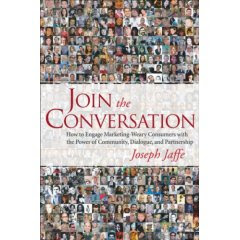
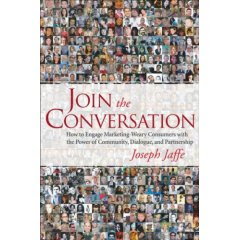
A much respected commentator and author on all things marketing, Joseph Jaffe, is running a small experiment to improve the sales of his current book. The intention is to see if the power of the network and social marketing is all we believe it is going to be in terms of influencing purchase behaviour. 

In October 2007 Joseph published a new book entitled "Join the Conversation".   Following the success of his previous books in generating reviews with other bloggers Joseph is, once again, trying to see if he can get his book on the best seller list by practicing what he preaches. Namely, using the power of conversation among networks to improve the level of purchase. He has named it UNM2PNM (Using New Media to Prove New Media). As his blog says...

'The underlying thinking behind this effort was that I would use the very approaches in my book to help market it and in so doing, would turn the book into its own case study.'

Obviously that kind of thinking appeals to us at Integer, and Joseph has offered a free copy of the book to different industry bloggers in return for their honest review of it. So we are going to be reviewing the book in the near future and take part in the experiment to try and use the power of this network and the conversation generated here can help to influence and encourage you all to shop for it (assuming it is any good of course).

It will be interesting to see what happens given the amount of book clutter that exists and free IP that is generated in the blog sphere - will the power of social media that we expect be able to move the needle and encourage greater purchase?

In the meantime, if you want to grab a copy of the book for yourself in advance, you can do so at amazon.  And do let us know if you buy a copy as a result of this post alone.

Who's Hungry?

HungerFrom a macro point of view we know that we feel good when we purchase a product that helps contribute to a cause.  From Susan G. Komen to (PRODUCT) RED, a lot of marketing support is put behind these efforts to make us aware and encourage us to purchase these products.

From an in-store perspective I think this is one of the best executions I've ever seen.  Leo Burnett Canada and Campbell's soup teamed together in the grocery channel for local foodbanks.  Here is a description of the program from directdaily:

In a grocery store 4,820 can s of Campbell's Soup were used to build an installation piece that spelled HUNGER. Signage beside the piece encouraged shoppers to buy one and donate it to their local food bank. As shoppers bought cans from the display the word HUNGER slowly disappeared. This allowed people to see how their individual effort could help bring an end to the problem of hunger.

This example works on a variety of levels, it 1) increases sales of Campbell's products 2) supports a great cause 3) provides a visual example of the difference one person can make.

- Contributed by Todd Cameron

Retail Surveillance

Retail_surveillanceAs I was reading the December 6, 2007 issue of the Economist, I couldn’t help but think of the irony involved as retailers attempt to create more personal environments for their customers.  The article, Watching As You Shop, points out the very impersonal technologies being developed and utilized by retailers around the world to learn more about their customers in order to provide them with a better shopping experience.

Customer monitoring software can now measure how long queue lines are at registers, which parts of the store are the most traveled, and how long customers stay in one place.  From Tesco in the UK to Walgreens, Best Buy, or Abercrombie & Fitch in the US, the channel is irrelevant as retailers are employing the technology to create a point of difference, and for good reason. 

In addition to a more pleasurable experience for customers, retailers are hoping to increase sales by learning what types of promotions are working and what areas are “hot spots” in the store for traffic flow.  Combine increased sales with more efficient staffing and retailers are not only increasing sales, they are cutting costs.

The players specializing in customer monitoring software range from companies such as Irisys and Brickstream to a consortium including manufacturers such as Coke and Procter & Gamble (P.R.I.S.M.) to university initiatives like VideoMining a spin-off from Penn State.

With this kind of focus already placed on how we shop, the technology to understand our actions in-store is only going to get more specific and actionable, begging the question: As consumers become aware of the technologies used to study their behavior, will they care? 

There is a lesson to be learned here from American Express.  When they openly discussed how they review cardholders' spending patterns to tailor offers to them, they faced a significant consumer backlash.  Even though they had been doing this for years, their cardholders felt betrayed.  My guess is that we as a culture are getting more comfortable with this type of information being gathered about us and as long as we believe we are getting a better deal or experience we won’t mind too much.

[Image: Irisys]

- Contributed by Todd Cameron

The Cosmetic Worlds Collide

Nc2007nov21_1_30 It used to be that one had two options for cosmetics and skincare - the drugstore or department store. Both had their advantages and disadvantages. At the drugstore, you had a multitude of choices, all at reasonable prices. But, there was no opportunity for experimentation or exploration. If the lipstick shade you bought was within three shades of what the picture looked like, you considered yourself lucky.

On the other hand, department stores were just waiting for you to come in and try. Unfortunately, they were crawling with pushy, overdone sales people committed to their lines, not to you.

Enter Sephora. The current Mecca of cosmetic retail, Americans are absolutely spellbound by endless rows of testers, hard to find products, and unbiased staff. It's like the Super Bowl of makeup. Each store is a mad house during every single business hour. They're opening new stores across the country like they're going out of style.

But there's still something missing. What happens when you do need advice? You can stick your hand in that shiny gooey stuff, but where the heck do you put it on your face? And what is the difference between that $100 eye cream and that $100 eye gel? Even if you can find a staff member who's not running around like a chicken with their head cut off, he or she's probably not going to be much for education. It's high-end product with low-end experience - like shopping Neiman's at Target.

Nc2007nov21_1_07If you're a lipstick whore (meaning you know your stuff), this is your spot. If you're a novice, god speed.  I still think there's opportunity in this market for a different kind of retail. Space NK, a British upscale Beauty retailer, is opening 4 stores in the Tri-state area by the end of the year. They have 60+ stores in the UK, and are bringing their unique retail approach to the US. Hallmarks of Space NK are hard-to-find lines, education and trial, makeup-trained sales staff (that aren't commissioned by line), and a chic, upscale atmosphere.

Nc2007nov21_1_22According to Space NK,

"We provide a highly edited selection of the best products from true innovators within the industry and this offering caters to many different lifestyle choices. We employ highly educated sales associates and expert make-up artists who enjoy working with customers."

While my guess is that nothing about this store is a bargain, you do get to test the products with trained, unbiased staff in the kind of environment you'd expect when you drop $250 on 12 oz of goodies. Here you can escape the madness that is Sephora, and the stuffiness that is (enter favorite department store here).

While we wait for the right balance of self service vs. trained staff, of get-in-get-out vs. stay-awhile, and of try vs. don't try, I can't wait to see how Space UK does. It's about time the beauty market went boutique.

Consumer Electronics Shopper Study

Ce_post Our Dallas office recently completed a very interesting study on shopper behaviour in the consumer electronics segment.  Topline findings were posted on adage.com yesterday.  The original article can be found here.   

The study takes an interesting look at the decision making process and the impact of various stimuli on the purchase decision in this category.

For more information you can contact Lisa Deatherage in the Integer Dallas office at [email protected].  Or check back soon for more on this.

(Photo credit: AP)