« December 2007 | Main | February 2008 »

January 2008

Luxury is a State of Mind

Reading a recent article in the Economist,I couldn't help but think of the implications on our work. There is a new study that provides scientific data backing up the effectiveness of brand building in marketing, an inherently difficult pursuit to quantify.  Call-to-action oriented campaigns have specific measures to quantify their success.  Branding campaigns are much more difficult to measure and often questioned by company executives especially when cuts need to be made.  But thanks to Dr. Antonio Rangel of the California Institute of Technology we now have the first study that demonstrates the effectiveness of branding.

The article is a synopsis of research published in the Proceedings of the National Academy of Sciences.  In it Dr. Rangel proves that a person's perception of a product directly affects his or her actual enjoyment of the product.  One example stated is a wine tasting conducted with both normal wine drinkers and a wine club.  In both instances when they tasted what was described as a $10 bottle of wine it rated less than half as good as when they tasted the same wine and were told it was a $90 bottle of wine.  The interesting twist here is that it wasn't people simply saying they enjoyed the $90 bottle more, brain scans actually indicated that they did derive more enjoyment from the perceived pricier bottle.  When the same test was conducted without price information, there was not the perceived difference.

The article focused on the why this happens in the brain and traces two possibilities back to survival and evolution.  I on the other hand kept thinking about how great this news is for those of us lucky enough to work with retailers and manufacturers, and the author does give a nod to that very same observation in the last paragraph.  Scientific evidence that reinforces the need for a thoughtful brand strategy is good news to all of us who have known it to be true since we started in this business.

- Contributed by Todd Cameron

Macy's push poll

Macys_surveyI recently made a purchase at the Macy's here in Denver's Cherry Creek Shopping Center. Everything was seamless and expected, including an overly cheery clerk at a cosmetics counter (the registers at the Men's Store were all occupied). 

But things went slightly south when, at the end of the transaction, the clerk urged me to fill out a survey that rated her performance.  She openly told me that if she received high scores she would receive a $25 gift certificate to Macy's.  She presented me with a laminated sample of the survey that highlighted Overall Shopping Experience with a red X in the box for Outstanding (see picture).

Perhaps what I saw was the handiwork of a renegade store clerk and a laminating machine.  Or maybe it was actually a store-issued program. 

Whatever the case, it feels emblematic of a larger abuse of customer service "research" that is growing in line with consumers' demand for high quality service. 

Another example from my own experience is at the dealership where I get my car serviced.  They must call me twice a month reminding me how much they are committed to my full satisfaction.  Urging me to be on the lookout for a survey call in the future.  Bludgeoning me with kindness. 

Not only is the research that comes of these studies flawed, but it must have a boomerang effect for some shoppers. 

So what's going on here? Are political research's infamous push polls leaking into the retail satisfaction space?  Where's a good brand cop when you need one?

I suspect it's a natural byproduct of the separation of sales and marketing.  And the simple fact that these are large companies, and it's no one's explicit job to be the enforcer.

But it all serves as a warning to those brand stewards working the floor, manning the counter, making the sales calls, designing the online checkouts: Beware the blurry line between serving and selling.

Shopping with your inner child

Upside_down_cake

Walking through the baking aisle at my local King Sooper's the other day, this jumped out at me.

Was it a stocker's practical joke?

A brand manager's under-the-radar experiment?

Or even an agency's idea?

My guess is it was none of the above (if you know the answer, or have seen something similar, by all means share!).

I'd put my money on the shopper.

A shopper gone wild.

A shopper frustrated with efficiency and straight lines at grocery.

A shopper who has not lost their sense of humor just because they're shopping.

This left me wondering whether we as marketers have lost some of our appreciation for childlike wonder in store.  Sure there are examples around to the contrary.  But you could say that the lion's share of in-store ideas over-rely on the power of rational claims.  On the impact of big signage.  On arresting video.  Or interruptive shelf talkers.

But when is the last time you paused in childlike wonder at something so simple as this?

May we all keep our inner shopping child alive and well.

Conversation to drive shopping - an experiement

A much respected commentator and author on all things marketing, Joseph Jaffe, is running a small experiment to improve the sales of his current book. The intention is to see if the power of the network and social marketing is all we believe it is going to be in terms of influencing purchase behaviour. 

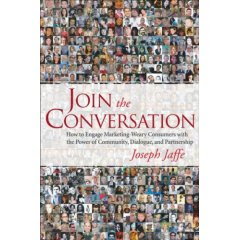
In October 2007 Joseph published a new book entitled "Join the Conversation".   Following the success of his previous books in generating reviews with other bloggers Joseph is, once again, trying to see if he can get his book on the best seller list by practicing what he preaches. Namely, using the power of conversation among networks to improve the level of purchase. He has named it UNM2PNM (Using New Media to Prove New Media). As his blog says...

'The underlying thinking behind this effort was that I would use the very approaches in my book to help market it and in so doing, would turn the book into its own case study.'

Obviously that kind of thinking appeals to us at Integer, and Joseph has offered a free copy of the book to different industry bloggers in return for their honest review of it. So we are going to be reviewing the book in the near future and take part in the experiment to try and use the power of this network and the conversation generated here can help to influence and encourage you all to shop for it (assuming it is any good of course).

It will be interesting to see what happens given the amount of book clutter that exists and free IP that is generated in the blog sphere - will the power of social media that we expect be able to move the needle and encourage greater purchase?

In the meantime, if you want to grab a copy of the book for yourself in advance, you can do so at amazon.  And do let us know if you buy a copy as a result of this post alone.

Who's Hungry?

HungerFrom a macro point of view we know that we feel good when we purchase a product that helps contribute to a cause.  From Susan G. Komen to (PRODUCT) RED, a lot of marketing support is put behind these efforts to make us aware and encourage us to purchase these products.

From an in-store perspective I think this is one of the best executions I've ever seen.  Leo Burnett Canada and Campbell's soup teamed together in the grocery channel for local foodbanks.  Here is a description of the program from directdaily:

In a grocery store 4,820 can s of Campbell's Soup were used to build an installation piece that spelled HUNGER. Signage beside the piece encouraged shoppers to buy one and donate it to their local food bank. As shoppers bought cans from the display the word HUNGER slowly disappeared. This allowed people to see how their individual effort could help bring an end to the problem of hunger.

This example works on a variety of levels, it 1) increases sales of Campbell's products 2) supports a great cause 3) provides a visual example of the difference one person can make.

- Contributed by Todd Cameron

Retail Surveillance

Retail_surveillanceAs I was reading the December 6, 2007 issue of the Economist, I couldn’t help but think of the irony involved as retailers attempt to create more personal environments for their customers.  The article, Watching As You Shop, points out the very impersonal technologies being developed and utilized by retailers around the world to learn more about their customers in order to provide them with a better shopping experience.

Customer monitoring software can now measure how long queue lines are at registers, which parts of the store are the most traveled, and how long customers stay in one place.  From Tesco in the UK to Walgreens, Best Buy, or Abercrombie & Fitch in the US, the channel is irrelevant as retailers are employing the technology to create a point of difference, and for good reason. 

In addition to a more pleasurable experience for customers, retailers are hoping to increase sales by learning what types of promotions are working and what areas are “hot spots” in the store for traffic flow.  Combine increased sales with more efficient staffing and retailers are not only increasing sales, they are cutting costs.

The players specializing in customer monitoring software range from companies such as Irisys and Brickstream to a consortium including manufacturers such as Coke and Procter & Gamble (P.R.I.S.M.) to university initiatives like VideoMining a spin-off from Penn State.

With this kind of focus already placed on how we shop, the technology to understand our actions in-store is only going to get more specific and actionable, begging the question: As consumers become aware of the technologies used to study their behavior, will they care? 

There is a lesson to be learned here from American Express.  When they openly discussed how they review cardholders' spending patterns to tailor offers to them, they faced a significant consumer backlash.  Even though they had been doing this for years, their cardholders felt betrayed.  My guess is that we as a culture are getting more comfortable with this type of information being gathered about us and as long as we believe we are getting a better deal or experience we won’t mind too much.

[Image: Irisys]

- Contributed by Todd Cameron