Conversation

Integer Pulse

Click the Integer Pulse tab under the Our Thinking section for a monthly update from our Midwest office. They explore some really interesting topics surrounding the shopping world. This months issue uncovers a trend/counter-trend they call "Get Real|Unreal World" which dives into the mindset of today's consumers. Getting real about spending habits while at the same time longing to escape to an unreal world.

Picture_5_3

Starbucks caffeinates sales with a shot of CRM

After two quarters of declining  sales and  executive-level scrutiny on brand health following reports that the company is straying too far from their brand roots, Starbucks is introducing five new initiatives to realign the company with their true identity. Interestingly, the most attention is being placed on CRM (customer relationship management) approaches to reward their most loyal customers and better understand their needs and desires. One of these initiatives is a standard customer loyalty-rewards program at retail, and another is a new style of website for customers and employees to share thoughts with the people who run the company.

Starbuckslogos

It appears Starbucks is practicing these concentrated CRM tactics to reclaim their position of being the customer's "Third Place" with home and work being number one and two. Third places are social environments generally revolving around beverages. Starbucks is fulfilling on this mission as having become a nationally accepted "Third Place" where consumers spend lots of money, time and collaboration. With their now declining sales, Starbucks recognizes that they must take consumer interaction and entertainment  to  a more subtle but effective level without being too obvious. Who wants a "Third Place" that feels uncomfortable, forced or inauthentic? But that doesn't mean you have to be home-grown and primitive in your communication or approach.

Consumers will soon be seeing something new in Starbucks retail environment with a loyalty-rewards program starting in mid-April. These "on the house" perks are for anyone who buys a Starbucks card and registers the card online, because Starbucks knows they can convert them to loyal users once they get to know them better. Participants will get free refills on coffee, a free cup of coffee when they buy a bag of whole bean coffee, hours of free Wi-Fi a day and "on the house" upgrades including syrups, soy milk, and extra whipped cream on all lattes. The in-person experience will also integrate online through monitoring and MyStarbucksIdea.com.

MyStarbucksIdea.com will initially include about a dozen categories. People can post, discuss and vote for ideas in categories such as coffee, atmosphere, food, music and social responsibility. Forty-eight Starbucks employees will respond to the posts then channel suggestions back to management. "Their job is to show up every day and engage with customers about their ideas," says CTO Chris Bruzzo.

We see two important aspects of CRM at work.

Better understanding core customers. Starbucks is embracing a highly streamlined approach in communicating to and understanding their customer with this online initiative maximizing on a CRM tool which is a smart way to "get to know" your customer, communicate directly with the customer, increase their purchases and monitor and enhance their overall brand experience (Starbucks is using Salesforce which is a top CRM/Sales tool with over 800 applications like these.)

Creating a customer-feedback protocol. Starbucks is getting great ideas directly from their customers creating a sense of involvement in the experience and overall ownership and participation by the customer. They actually show when the consumer's suggestions are "under review" or "coming soon". Each suggestion is acted on; people can view results by participating in this forum. While the suggestions are a form of user-generated content that others enjoy to read, vote on and celebrate successes when Starbucks adopts the new ideas, these comments are also indicative of Starbuck's general business model. The comments imply that Starbucks moves fast and get things done.

Other companies like Dell have joined Starbucks in implementing these innovative tools. Visit www.dellideastorm.com to see the Dell CRPM application taking hold.

We suggest more brands step outside of the comfort zone and taste-test CRM and digital technologies to understand how simple and straightforward they can be. Cost-effective technology is at your fingertips where consumers literally "tell you" what they want, and the tools allow easy customization of direct communication to niche audiences. These techniques could make a venti difference in your sales.

- Contributed by Tracy Kollker

Family and friends have greatest influence over our shopping

In an article in Advertising Age today, Zenith Optimedia are about to release some data that shows:

a) Friends and family are the most influential touchpoint when it comes to influencing our shopping decisions

b) TV is still top dog for creating brand associations.

What Zenith have done is create a database of all the studies they have undertaken using the Market Contact Audit (MCA) methodology, a proprietary research and analytics methodology belonging to Integration Marketing Communications that is used by many brands around the world (many agency groups have licenses to sell and use the MCA).

Being one of those agencies and having used the MCA with a number of clients as part of our Connections Planning approach (we're fans), these aggregated findings that Zenith are going to make available don't really surprise.  The level of detail they share though will be interesting.

One mistake that I've seen clients make when using the MCA is to look only at the surface level measures - like those shared in the AdAge article. What gives the most 'clout' in this category? How is our brand performing in each channel (through the association measure)? This is to miss a great deal of the value in the methodology and is a superficial look at the findings. The MCA delivers so much rich insight into the return that channels are generating, messaging effectiveness and competitor strategies amongst other things. It is a great single source approach when you know how to read it and apply it properly.  If you have any interest into how your marketing is performing and the return it is bringing, you should consider it.

Really looking forward to what the is shared by Zenith and their aggregation exercise

Conversation to drive shopping - an experiement II

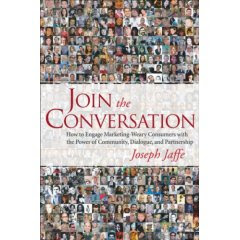
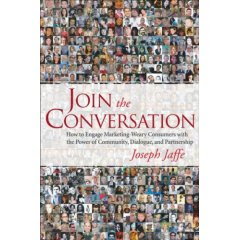
It has taken me too long to get to my promise of reading this book. My mistake, as if you have even a vague interest in how to ensure your brand is a success in the future then I recommend you give this a read.  Joseph Jeffe (who also wrote Life after the 30-second spot) has set up this experiment to use new marketing to prove the power of new marketing.  In taking part, I owe everyone a review of the book.

I'm not sure Joseph's writing style is to everyone's taste but the fundamental point about the change in the landscape brands now play on and the need to re-think how we engage people is well made and an important contribution to modern marketing.

So what did I learn from the read, given that the purpose of this blog is to host a discussion?  Well, this is a book about change, evolution, adaptation and experimentation.

- It reminded me of how we all change our mentality when we cross the threshold of our places of work. We have conversation outside the building - inside, we tend to push out reams of (often) meaningless communication in the eyes of the intended recipient.

- That to partake in a conversation, you have to have something interesting to contribute - a challenge for many. How many brands in the world could hold an interesting conversation at a BBQ? Or in the aisle of a supermarket? And it's not about just opening your mouth, you have to have something to say.

- That many brands do not understand the notion of audience - otherwise the aggressive or de-humanising stance that some advertisers take would be less prevalent. Remember guys, we're all audience to something, we all talk.

- That whatever we do, brands are increasingly bouncing in the market (spoofing, generating echoes) - or they should be looking to do so. Joseph talks of the 'movement of parts of the conversation that alter and shift every time they hit the dirt'. (Although I felt the notion of a Chief Conversation Officer as a new role slightly sinister for some reason).

- The importance of listening in conversation.  Something we've been doing  bunch of work on in the Insight & Strategy Group here in Denver.

There are also some useful and funny stories of brands slapping their customer's for using them. I'm sure they won't bring the organisations down, but they provide useful learning for others.

The conversation carries on in a number of places.  First off there is the site that accompanies the book, there is Joseph's excellent blog (and his podcasts are also worth a listen) which Morgan is an advocate of, and you can also join the Facebook group. I have also posted a similar review here.

And if you happen to be in close geographic proximity to me, or you're first to comment and ask, I'd be happy to lend you my (slightly dog-eared) copy. But I do suggest you buy yourself a copy for your own bookshelf from amazon.com.

Conversation to drive shopping - an experiement

A much respected commentator and author on all things marketing, Joseph Jaffe, is running a small experiment to improve the sales of his current book. The intention is to see if the power of the network and social marketing is all we believe it is going to be in terms of influencing purchase behaviour. 

In October 2007 Joseph published a new book entitled "Join the Conversation".   Following the success of his previous books in generating reviews with other bloggers Joseph is, once again, trying to see if he can get his book on the best seller list by practicing what he preaches. Namely, using the power of conversation among networks to improve the level of purchase. He has named it UNM2PNM (Using New Media to Prove New Media). As his blog says...

'The underlying thinking behind this effort was that I would use the very approaches in my book to help market it and in so doing, would turn the book into its own case study.'

Obviously that kind of thinking appeals to us at Integer, and Joseph has offered a free copy of the book to different industry bloggers in return for their honest review of it. So we are going to be reviewing the book in the near future and take part in the experiment to try and use the power of this network and the conversation generated here can help to influence and encourage you all to shop for it (assuming it is any good of course).

It will be interesting to see what happens given the amount of book clutter that exists and free IP that is generated in the blog sphere - will the power of social media that we expect be able to move the needle and encourage greater purchase?

In the meantime, if you want to grab a copy of the book for yourself in advance, you can do so at amazon.  And do let us know if you buy a copy as a result of this post alone.

My Photo

Our Thinking

  • White Papers
  • Shopper Pulse - Trend Update
  • About the 2007 Electronics Shopper Study
  • About the 2006/07 Shopper Study

Inconvenience

  • An Inconvenience Truth
    A link to a blog where we are collecting stories about the things you find inconvenient in life.

Search


  • WWW
    shopperculture.com

The original shopper culture study

Other stuff

  • PRIVACY POLICY
  • TERMS OF USE